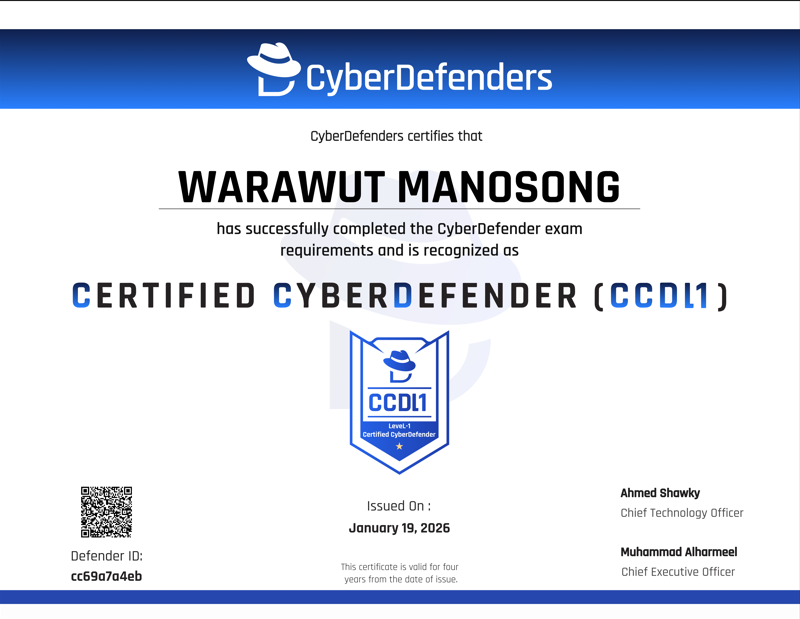
CCDL1 (Certified CyberDefender Level 1 Certification) Review
Hello everyone! It's me, Chicken0248, again, and in this blog we'll talk about the Certified CyberDefender Level 1 (CCD L1) certification: the newest certification from the CyberDefenders platform, which is well-known for its cyber range and blue team labs. I've even made some labs for them myself!
CyberDefenders already has one well-established certification, CCD (Certified CyberDefender), but with the growing trend of SOC L1 and Junior SOC Analyst certifications, many platforms (including big players like TryHackMe) have been launching their own entry-level SOC certs to compete in this space.
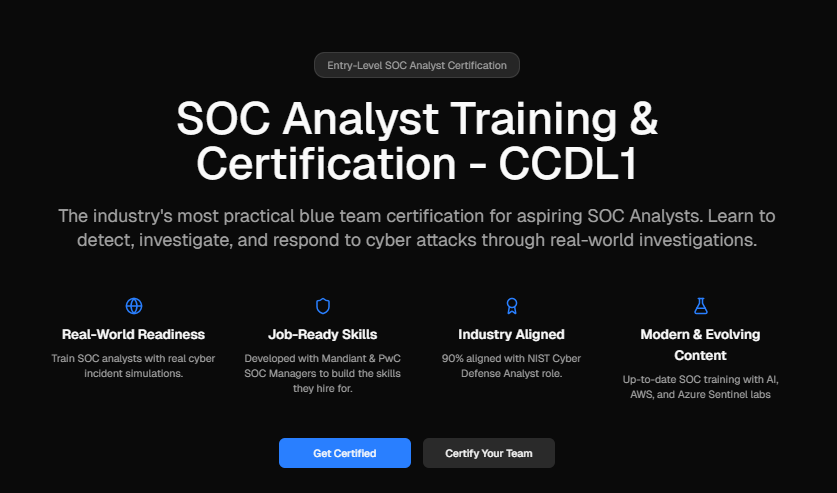
SOC Analyst Training & Certification — CCDL1
Since CCD (which we can now think of as CCD L2) is regarded as an intermediate-to-advanced certification for blue teamers and SOC analysts, CyberDefenders finally introduced CCD L1 for the SOC L1 audience. I was fortunate enough to join the beta access for both the course and the exam, so keep in mind that this review reflects the beta state, and some content or exam details may have changed since.
Let's talk about pricing first, because it sets expectations. CCD L1 is priced at USD 500, putting it directly on par with BTL1 (GBP 399 ≈ USD 500), its most direct competitor and one of the most established SOC L1 certifications on the market. CyberDefenders is clearly positioning this as a serious contender, and that ambition shows clearly in the course content.
The CCD L1 course is divided into six modules that you'll need to complete within four months:
- SOC & Threat Intelligence Foundations
- Network & Endpoint Essentials
- SIEM Basics (Splunk & Sentinel)
- Phishing & Email Security
- Digital Forensics and Incident Response
- Cloud Security & AI
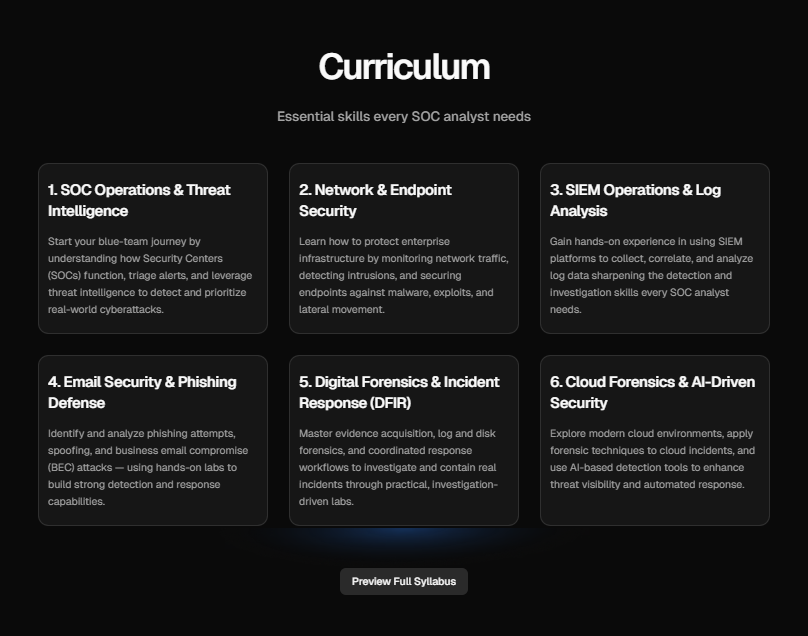
Check out the full syllabus here.
Each module covers a different area: some focusing on mandatory SOC fundamentals, others going well beyond what most SOC L1 analysts would encounter day-to-day. In many cases, the course teaches advanced concepts and real execution that you'd only get to apply in a startup or a very lean SOC environment.
Even for me (having already gone through BTL1, SAL1, PSAA, and HTB CDSA), there were sections I genuinely struggled with. Topics like Microsoft Sentinel, rkhunter, OpenCTI, and AWS log analysis were either new to me or covered at a much deeper level than I expected.
Notably, the course covers Cloud (AWS) and Microsoft Sentinel, which is still surprisingly rare in most SOC-focused courses available today.
As a beta access member, I watched the content evolve significantly over time. Early on I didn't engage heavily: the material still had room to improve. Later, CyberDefenders announced they would revoke beta access and refund users with little to no activity, since the main goal of the beta phase was to collect feedback. They also launched a beta leaderboard event where the top three participants (measured by lab completions, lessons, investigations, and feedback) would receive a CyberDefenders subscription. That's when I decided to speedrun the course, and I was genuinely impressed. The labs are well-designed and include detailed walkthroughs, which are extremely useful for building the right investigation mindset when you get stuck.
In addition to labs, each module has its own Investigation: essentially a post-knowledge test without walkthroughs. Students can discuss findings and ask for hints in dedicated Discord channels for each investigation.
Here's a non-exhaustive list of tools used across the course:
- OpenCTI
- TOR Browser
- AlienVault OTX
- VirusTotal, Any.Run, and Hybrid Analysis
- Wireshark
- Splunk
- Microsoft Sentinel
- AWS Log Analyzer
- n8n
- oletools
- GoPhish
- log2timeline
- Eric Zimmerman's Tools (selected) and KAPE
- DB Browser for SQLite
- Autopsy
- FTK Imager
- Volatility
- rkhunter
- AIDE
And the list goes on.
Although the certification name suggests it is designed for SOC L1, the course content clearly exceeds what an average SOC L1 analyst would normally handle. Examples include:
- Decrypting Cobalt Strike C2 traffic
- Shellcode extraction and debugging from email attachments
- n8n workflow integration with Splunk and threat intelligence automation
Without a solid foundation, you will get stuck, but that's not necessarily a bad thing. The detailed walkthroughs give you the tools to learn new techniques and gradually build a stronger foundation.
If I had to score the course alone, I'd give it 4.8/5. It's long and dense, but the content is information-rich, the walkthroughs are thorough, and the topic coverage spans both essential and advanced areas.
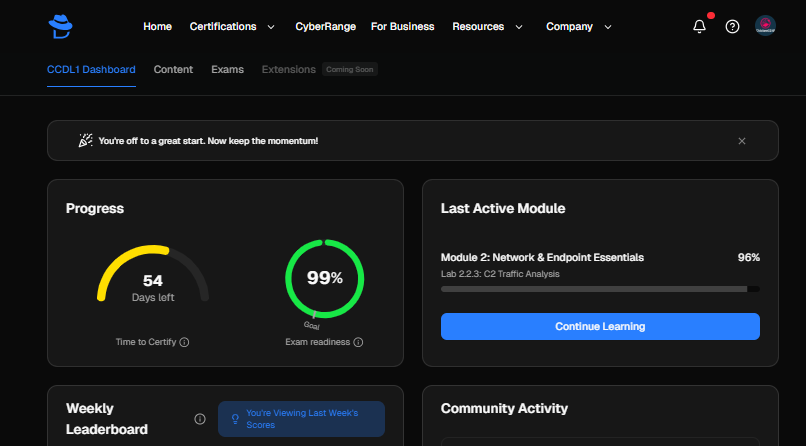
CyberDefenders has an Exam Readiness feature that tracks your progress through the course. In practice it's more of a completion tracker than a true readiness indicator, but hitting 90%, where the majority of the score comes from labs and investigations, does a good job of building confidence before you sit the exam.
For my own preparation, I reviewed all the modules again and built an index: a structured list of topics and labs with hyperlinks, so I could jump directly to a relevant section if I encountered something familiar during the exam.
If you're wondering whether any external labs are worth doing beforehand: honestly, I think the course labs and investigations are sufficient. Any cyber range labs I could point you to would likely feel "out of scope" in some sense and might leave you feeling underprepared rather than more confident.
Beyond that, I didn't do much additional preparation: this is a SOC L1 exam and I had completed 99% of the course (the remaining 1% was pure laziness). I then waited for the exam to be released. One thing we knew in advance: the exam would be MCQ-format, but not theory-based. Every question would require you to perform an actual investigation before selecting the right answer: no guessing your way through. I appreciate this approach. It gives students instant results without the need for manual grading (as the original CCD requires), and I'm glad they didn't go down the AI-graded path like SAL1 or the OffSec Gauntlet.
A couple of months passed, and on 18 January 2026 I received an email inviting me to try the exam. I was one of ten beta testers selected for this. Since 19 January was a Monday and I knew I'd be busy from Tuesday onward, I attempted the exam that same evening after getting enough rest from work.
When I clicked Start, I had to select a region for the exam instance: this directly affects lab performance, so choose the closest one to you. After waiting 6–8 minutes for provisioning to complete, I was in.
All the information I needed was presented upfront. As mentioned, the exam is MCQ-format, but nothing like the theory-based MCQs from CompTIA CySA+ or SAL1. Every question required real technical analysis to find the correct answer. I also only then realised I had just 5 hours to complete everything. After exploring the lab environment to get my bearings, I made my first move, and from there, it was smooth sailing. The exam calibration feels right for a SOC L1 certification.
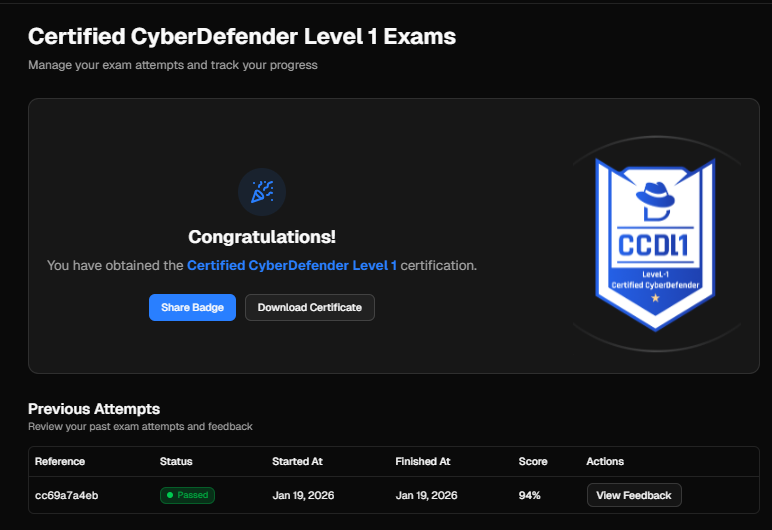
Within 3 hours (it could've been faster, but I was ordering dinner mid-exam), I submitted and scored 90%+. I thought a perfect score was within reach, but 90%+ is more than enough, and if CyberDefenders ever introduces a gold distinction for CCD L1, I'd still qualify. Pass is pass regardless of the score.
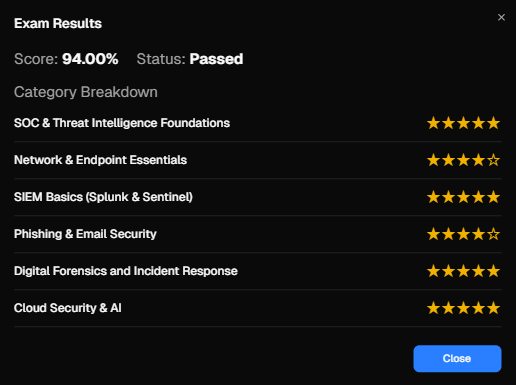
The View Feedback button reveals a domain-by-domain breakdown of what you did well and where to improve. There were two areas where I scored lower: both times because I was too lazy to dig deeper for the answer.
After passing, my Discord account was automatically granted the Certified CyberDefender role. Since there's no dedicated CCD L1 role yet (the existing role was originally created for CCD), I gladly accepted it.
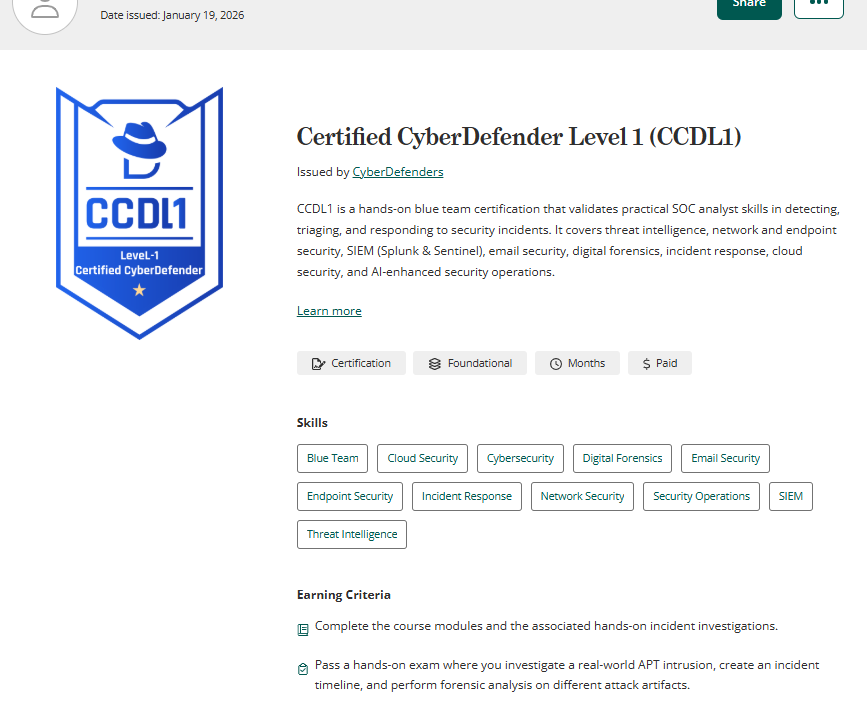
That's it for my exam experience, fairly short, all things considered. Let's move on to my final review.
In my opinion, CCD L1 is one of the best SOC courses currently available on the market. The content goes well beyond what is typically expected from a SOC L1 role: covering Microsoft Sentinel, AWS, Cobalt Strike C2 traffic analysis, shellcode extraction, and a touch of malware analysis. These are topics more commonly associated with advanced SOC or DFIR positions.
That said, CCD L1 is still suitable for SOC L1 analysts, it just isn't easy. Anyone new to cybersecurity or early in their SOC journey should expect to struggle at times. The learning curve is steep; the course doesn't linger at fundamentals and frequently dives into advanced concepts and real-world execution. Without a solid foundation, the material can feel overwhelming, but it's also extremely rewarding if you push through it.
If you digest the content, truly understand it, and later land a SOC role, you may find that many SOC L1 positions focus primarily on alert triage (deciding what to escalate and what to close) with limited exposure to DFIR work or automation. In that sense, CCD L1 can leave you feeling somewhat overqualified for certain entry-level roles.
There are, of course, exceptions. In certain countries or organisations (especially those building or operating a SOC from the ground up), this depth of knowledge is extremely valuable and helps bridge significant technical gaps.
To be clear: the labs, the course content, and the exam are all excellent. The concern is not quality. It's expectation management. CCD L1 is ideal for anyone who wants to go beyond basic alert handling and gain hands-on experience with Microsoft Sentinel, AWS, and real-world attack analysis. SOC L1 analysts can absolutely benefit from this course, as long as you're prepared to struggle, learn, and grow through material that regularly exceeds your current level.
- Build a course index: a structured list of topics covered in each lab with hyperlinks, so you can jump directly back to relevant material when you encounter something similar in the exam.
- Always maintain an incident timeline as you work through the exam.
- Build your own cheat sheet of commands and queries: whether for Volatility, Eric Zimmerman's tools, Splunk, AWS, or anything else. (I built mine while playing through threat hunting labs on the cyber range, and it meant I didn't need to craft new queries from scratch during the exam.)
- If a tool prints output to stdout, pipe it to a text file so you can read it again later without re-running the command.
- When working through labs, always read the walkthroughs, even if you solved the lab yourself. They reveal the mindset of the course authors, which directly maps to what the exam expects.
That's it for today, good luck to everyone going for this exam!
Peace ✌️