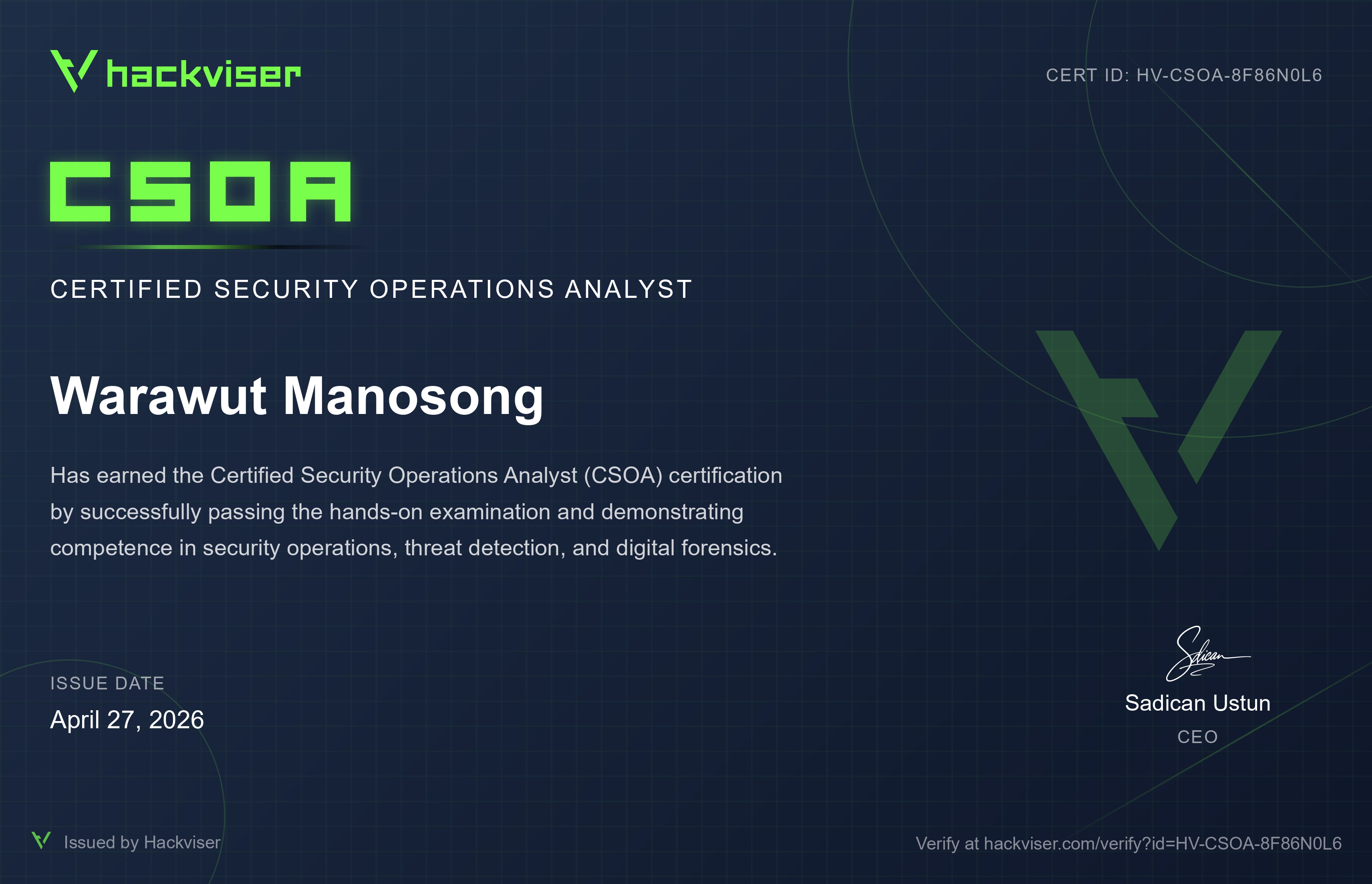
Hackviser CSOA Review: The Path is Solid, The Exam is Not
Hello everyone, Chicken0248 here again with the Certified Security Operations Analyst (CSOA) certificate from Hackviser, their first blue team certification. The interesting thing about this platform is that they went with the same approach as HackTheBox: all certifications have a dedicated learning path you need to complete before taking the exam, and the exam is supposed to be the ultimate test of everything you learned.
Sad to break it to you, for this one it's not. Why? Let's get into it.
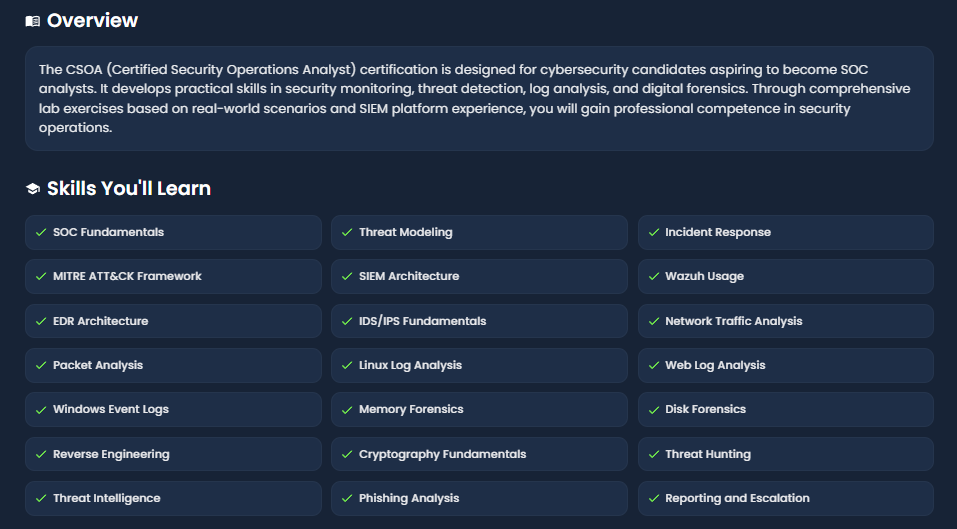
First, what is CSOA exactly? Hackviser claims it's designed for candidates aspiring to become SOC analysts, where you'll develop practical skills in security monitoring, threat detection, log analysis, and digital forensics. A wide range of skills, and the path does back that up.
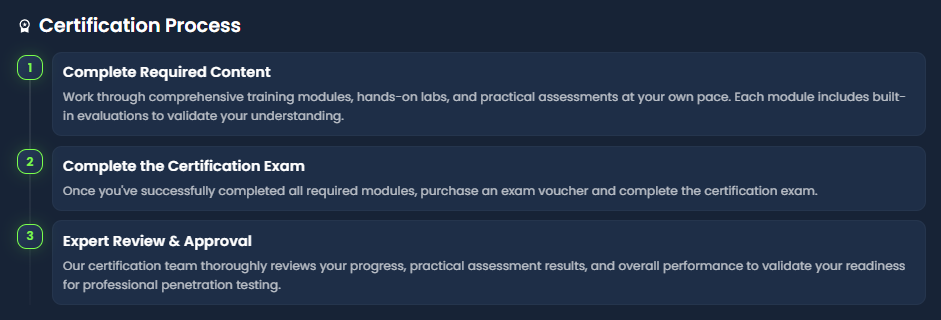
To take the exam, you must first complete the learning path. Once done, you submit for approval before actually receiving the certification. A funny detail: the placeholder text in the certification process still reads "professional penetration testing," a copy-paste leftover they clearly forgot to update.
With that, let's jump into the learning path.
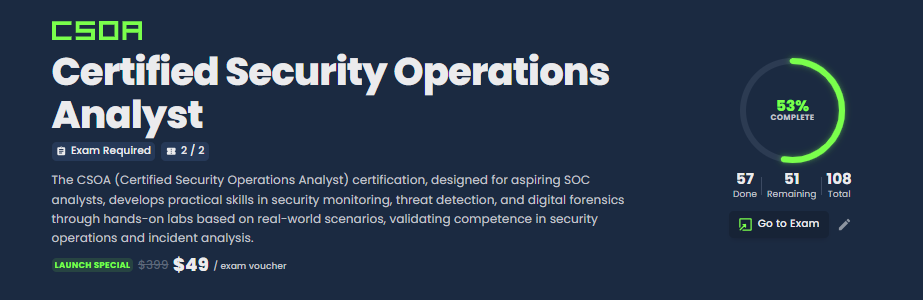
The CSOA path consists of 108 labs grouped into 10 modules:
- SOC Fundamentals & Threat Modeling
- Infrastructure Fundamentals
- Threat Vectors & Attack Surface
- Security Monitoring Technologies
- Network Forensics
- Endpoint Forensics
- Reverse Engineering
- Cryptology Fundamentals
- Threat Hunting
- Real-World Scenarios
The coverage is well-rounded. Throughout the path you'll use Wazuh to investigate security incidents, work through basic cryptography challenges, dig into network protocols with Wireshark, practice digital forensics using Eric Zimmerman's tools to parse Windows artifacts, run Volatility for memory forensics, and even work on WAF bypass techniques, which is the most challenging lab in the path for a blue teamer. You'll also learn to unpack well-known packers like UPX, ASPack, MPRESS, Themida, and PyArmor.
The path is designed to be completed in 1 to 2 months. Coming in with a solid foundation already, I finished it in about 2 to 3 days and started the exam on Sunday, April 19th 2026.
One thing worth noting: accessing the path requires an active subscription at $12/month. I opted for just one month and used it solely for this path, since there aren't many advanced blue team labs on the platform yet.
Once you've completed all the modules, it's time for the exam.
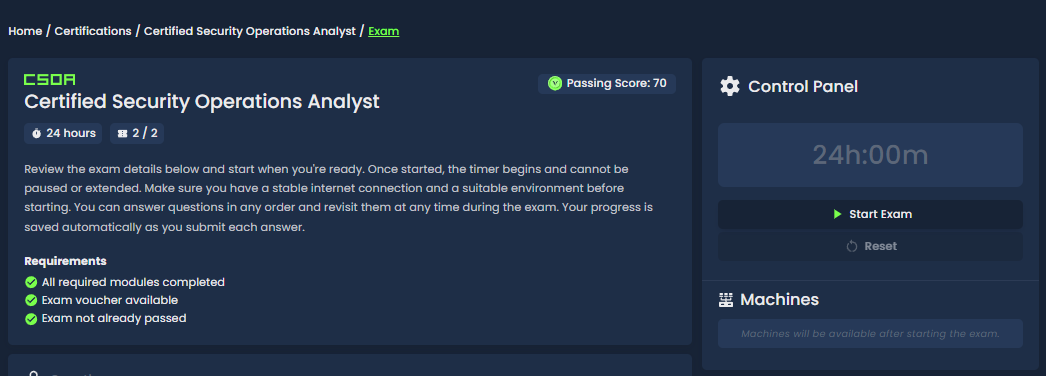
Since CSOA had just launched, I grabbed the exam voucher for only $49 (down from the full price of $399). I honestly doubt anyone would pay full price anyway since Hackviser regularly discounts their certifications, just look at CWSE and CAPT for reference.
The voucher gives you 365 days to take the exam, with 2 attempts included.
The exam itself is a 24-hour format with no report submission required. You submit answers the same way you did throughout each module, and you know immediately whether you got it right because the system only accepts the correct answer.
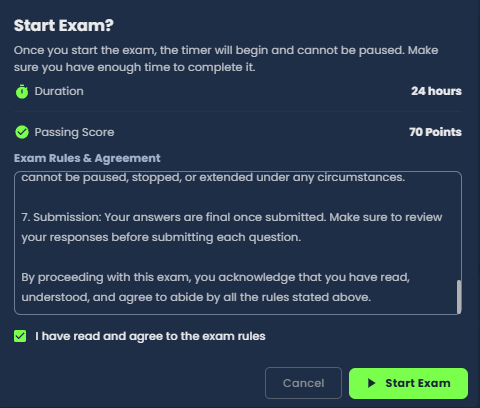
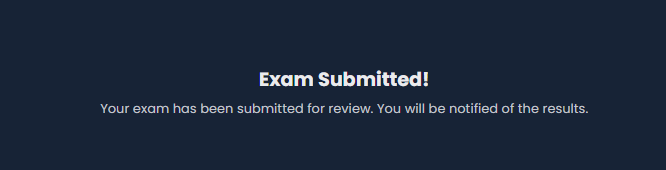
I started at 6:15 PM while waiting for a dinner delivery and submitted at 6:54 PM. The actual time spent was probably under 45 minutes since dinner arrived in between. Finishing in about 15 minutes is completely realistic.
And this is the core problem: the exam does not reflect the full scope of the path at all. It only touches a tiny portion of what you learned. That's simply not how you design a test for a path built around teaching you a wide variety of skills.
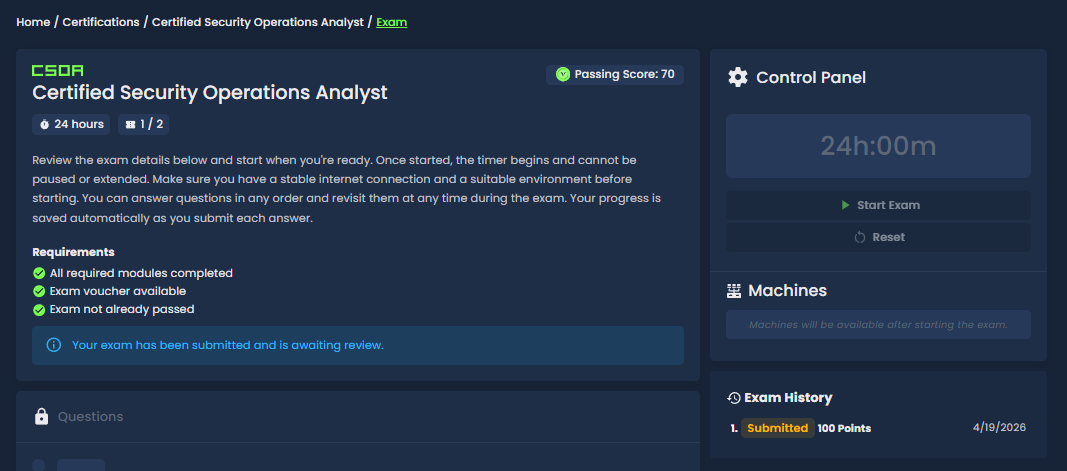
After submitting, the waiting game begins. It's unclear why the exam isn't automatically graded, since the system only accepts correct answers. My best guess is they review activity around the exam date to check for cheating before issuing the certificate, but that's pure speculation.
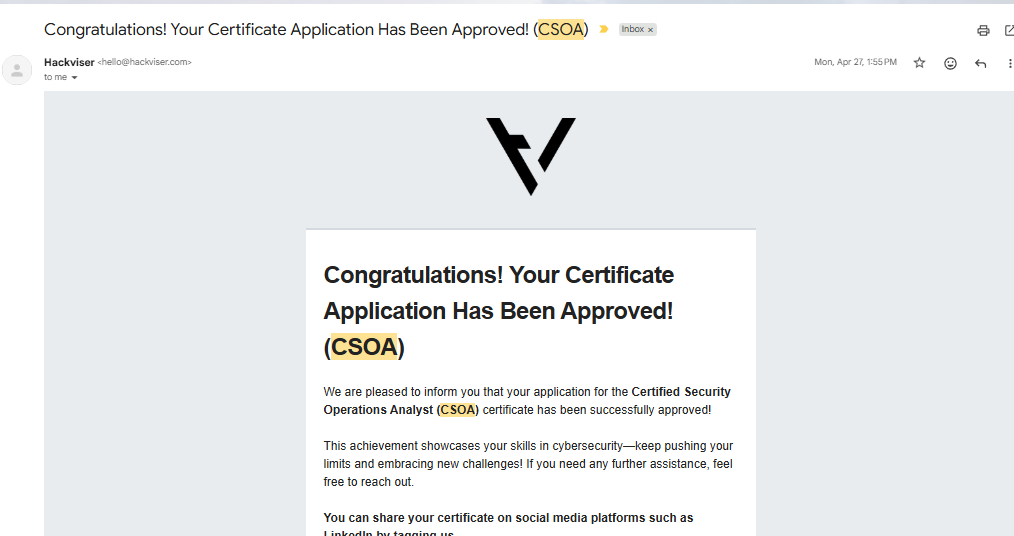
I ended up waiting about 2 weeks before the certificate was issued on April 27th, 2026.
The path itself combines fundamental knowledge, penetration testing concepts, and blue team skills in a way that actually makes sense together. For someone looking to break into the SOC analyst space, it gives a genuinely well-rounded experience and the lab quality is good enough that you won't feel like you're wasting your time. Covering everything from log analysis and Windows forensics to memory forensics, reverse engineering, and WAF bypassing shows that Hackviser put real thought into what a modern SOC analyst should know.
The exam is where things fall apart. After going through 108 labs across 10 modules covering a wide range of skills, you'd expect the exam to challenge you across all of that. Instead it only scratches the surface. For a 24-hour exam that's supposed to be the ultimate test, that's a pretty big miss. It almost feels like the exam was an afterthought, built separately from the path rather than alongside it.
At $49 launch price, it's hard to complain too much. At full price of $399, the gap between what the path promises and what the exam delivers would be very difficult to justify. If Hackviser revisits and reworks the exam to truly reflect the depth of the path, this certification could be something worth recommending without hesitation.
For now: take the path, enjoy the labs, just don't expect the exam to push you.